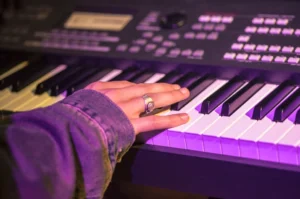
For producers who want to write in this style, the question isn’t whether these chords matter anymore. It’s how to actually use them in practice.
There are two common paths:
Both are valid. They simply serve different goals.
The Case for Learning Neo-Soul Harmony Properly
Learning neo-soul harmony from the ground up is a real skill—and a valuable one.
It usually involves:
-
understanding extended chord construction (maj7, m9, b13, altered dominants)
-
voice-leading between chords
-
practicing voicings across all keys
-
developing muscle memory on piano or guitar
-
learning when to simplify harmony for vocals
For musicians who want long-term mastery, this path pays off. It allows complete harmonic freedom and deep musical intuition over time.
The trade-off is speed.
Developing this level of fluency takes months or years of consistent practice, and even then, applying it quickly under songwriting pressure isn’t always straightforward—especially in pop-focused production environments like K-Pop.
The Reality of K-Pop Production Workflows
K-Pop production is rarely performance-driven in the traditional sense.
Sessions move quickly. Songs are often written collaboratively. Arrangements are revised constantly. The goal is not to showcase harmonic complexity, but to support melody, emotion, and structure efficiently.
Because of this, many K-Pop producers work directly inside the DAW, constructing harmony in the piano roll rather than playing everything live. MIDI-first composition allows precise control over voicings, timing, and movement without being limited by real-time execution.
A well-known example is producer Tim Tan, who has worked with artists including aespa. His workflow in Cubase involves programming notes directly into the piano roll rather than relying on performance. This allows harmony to be shaped deliberately—note by note—based on what best serves the song.
This approach is not unusual. In fact, it’s extremely common across modern K-Pop production.
Why neo-soul harmony became so prominent in K-Pop.
Theory vs MIDI — The Workflow Trade-Off
Listen to this audio:
Now ask yourself how much energy would be spent not only figuring out an interesting progression, but breaking it into a rhythmic or performance-based format like this — before sound design even enters the picture.
In K-Pop production, where tone and texture are critical and generic sounds are rarely used, that trade-off often determines how far an idea actually gets.
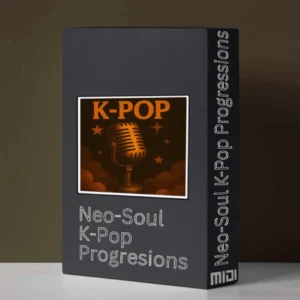
The above audio example is taken from Neo-Soul K-Pop Progressions, a MIDI pack for modern K-Pop workflows.
MIDI as a Practical Entry Point to Neo-Soul Harmony
Because of these workflows, neo-soul harmony is often accessed through pre-voiced MIDI chord frameworks.
Instead of constructing every voicing from scratch, producers start with progressions that already contain:
From there, chords are edited, reharmonized, rhythmically reshaped, or layered with different instruments. MIDI makes this process fast and flexible—ideal for pop songwriting, where harmonic richness needs to feel natural rather than academic.
This doesn’t replace understanding harmony. It bridges the gap between theory and output.
Melodic Samples vs MIDI — Why Chords Are Treated Differently
In modern K-Pop production, melodic samples are everywhere but chords are used differently.
Melodic samples are often reused as motifs or textures. They’re looped, filtered, and repeated to create familiarity across a track.
Harmony isn’t treated that way.
Chord progressions are constantly adjusted to support melody, vocals, and emotional movement. Even when the progression stays similar, voicing, rhythm, and register usually change between sections.
This is why harmonic material is typically handled as MIDI rather than audio.
MIDI allows chords to be revoiced, reshaped rhythmically, and adapted to different sounds as the arrangement evolves — something that’s difficult once harmony is committed to audio.
Samples excel at repetition.
MIDI excels at flexibility.
In fast-moving K-Pop workflows, that distinction matters.
When Learning Theory Makes Sense — and When MIDI Is Smarter
The choice between learning neo-soul harmony and using MIDI isn’t an either/or decision.
Learning harmony deeply makes sense if:
-
your long-term goal is musicianship
-
you enjoy theoretical study
-
you want total harmonic freedom
-
you’re not under constant production deadlines
Using MIDI-based harmony makes sense if:
-
your priority is songwriting speed
-
you’re producing pop or K-Pop regularly
-
you work mainly in the DAW
-
you need reliable harmonic foundations quickly
In practice, many producers do both: understanding the language while using MIDI to apply it efficiently.
Turning Understanding into Output
Understanding why neo-soul harmony works in K-Pop gives you musical context. Applying it consistently is what actually leads to finished songs.
For producers who want immediate access to neo-soul-influenced chord and rhythmic foundations in a K-Pop context, Neo-Soul K-Pop Progressions provides MIDI-based progressions designed specifically for modern K-Pop songwriting—allowing you to focus on melody, arrangement, and emotion rather than building every voicing from zero.
Neo-Soul K-Pop Progressions
Final Thoughts
Neo-soul harmony isn’t what makes K-Pop complex. It’s what makes it expressive.
Whether you choose to learn that language in depth, use MIDI-based workflows, or combine both approaches depends entirely on your goals as a producer. What matters is having a practical way to translate musical ideas into finished records—without losing momentum in the process.
In modern K-Pop, efficiency and emotion matter just as much as theory.